
One Thousand Conversations: The Movement
One singular action that changes how students see memory.
Over three days this week, April 28, 29, and 30, Haverhill High School led its entire ninth grade through live, expert-guided tours of Auschwitz-Birkenau, broadcast in real time from Oświęcim, Poland by the Auschwitz-Birkenau Foundation. Six hundred students. The entire ninth grade. Twenty-four independent classroom tours across three days, each classroom connected to its own guide, each small group of students able to ask their own questions, in real time, of an educator standing on the ground where history happened.
This was not a single broadcast to a passive audience. It was twenty-four simultaneous human conversations between students in Massachusetts and expert guides at one of the most profound memorial sites the human race has ever created. Students raised their hands. They asked questions. They received answers from someone standing in the barracks, on the platform, beside the ruins of the crematoria. That human connection, across an ocean, across decades, is what makes this different from any documentary, any textbook, any film. The guide was there. The students were there. And the ground they were standing on, and looking at, was real.
Each day’s tour ended. And each day, something began.
Consider what happens after a moment like this. A student turns to the person next to them and says something. A question. An observation. A single word that carries the weight of everything they just saw. Walking to the next class, it spills out again. In the hallway. At lunch. In the classroom after, where students who watched together begin to process together, and then connect with students who watched the day before, or last year, or the year before that. By the end of three days, six hundred students were carrying the same weight, and talking to each other about it.
This is not a theory. It is observable. In the hallways between classes, in the lunchroom, in the classrooms before the bell, the conversations were happening. Haverhill’s lead teacher of Holocaust and Genocide Education was listening for them, because that is what you do when you build a program like this: you pay attention. You watch for the signs. You ask yourself every year, is it working? And the answer this week, heard in passing, overheard at lunch, seen in the body language of students still processing what they witnessed, was yes. The tours were real to them. As close as we could get them to standing on that ground. And because it was real, they talked about it. They are still talking about it.
That afternoon, each student goes home. At dinner, or in the car, or before bed, they say something to a parent. They ask what the family knows. They ask where they come from and whether any of this history touched them. In a school like Haverhill’s, many students are new to this country. Some have never heard the word Holocaust before this week. Tonight, those students will be the ones teaching their parents. A fourteen-year-old in Haverhill, Massachusetts will sit across from a mother or father and say: I saw something this week. I spoke to someone who was standing there. Let me tell you what it was.
Now multiply that by six hundred.
Here is the rationale for the One Thousand Conversations Movement. It is not a projection. It is not an estimate designed to impress. It is a conservative accounting of what actually happens when young people witness something this significant, grounded in three years of watching it happen.
More than half of six hundred students will share what they saw with at least one other person outside of school. Most will share it more than once. Each day of the three-day tour, three hundred students re-entered their hallways, their homes, and their communities carrying something new. By the end of the week, the conversations had already begun multiplying: student to student, student to parent, student to sibling, student to community. In the days that follow, they will bring it up when something in the news connects to it. Some will carry it for years and surface it when a moment calls for it: a classroom of their own someday, a conversation with their own child, a dinner table where someone says something ignorant and they know better because of what they saw in ninth grade in Haverhill.
Three days. Twenty-four tours. Six hundred students. Two thousand conversations, at minimum, beginning right now. Spreading outward into families, into communities, into futures that cannot be predicted or measured, but that are real.
Now consider what happens if this is not only Haverhill.
The Auschwitz-Birkenau Foundation has confirmed that Haverhill Public Schools is the only school system in the world that has built this live, expert-guided tour into its curriculum for an entire grade level, every year, as a required part of the course. Haverhill is the only one. But Haverhill does not need to be.
The One Thousand Conversations Movement begins with a simple proposition: every day a school arranges these live, small-group tours for an entire grade of students, one thousand conversations will follow. Those conversations will happen in homes, in hallways, in communities, in languages the school will never hear. They will happen years from now, when something triggers a memory and a former student says: there is something you need to know. Something Haverhill taught me to say.
If one school system can do this, others can too. The infrastructure exists. The Auschwitz-Birkenau Foundation has the capacity. What is required is the institutional decision that this history belongs in the curriculum, not at the margins of it, and the belief that young people are ready to bear witness if we trust them enough to ask.
This week was Haverhill. Twenty-four tours. Six hundred students. Two thousand conversations beginning right now, rippling outward from thirty classrooms in one school in one city in Massachusetts, where an entire grade of young people made a human connection to one of the most important memorial sites the human race has ever created, and then went home and started talking.
Imagine what happens when it is not just one city.
That is the movement. That is why Haverhill does this. And that is the invitation to every school that reads these words.
The One Thousand Conversations Movement invites schools and school systems to bring live, small-group, expert-guided Auschwitz-Birkenau tours into their curriculum for an entire grade level. For information on how Haverhill Public Schools built this program, contact Ted Kempinski, Lead Teacher of Holocaust and Genocide Education, Haverhill Public Schools.
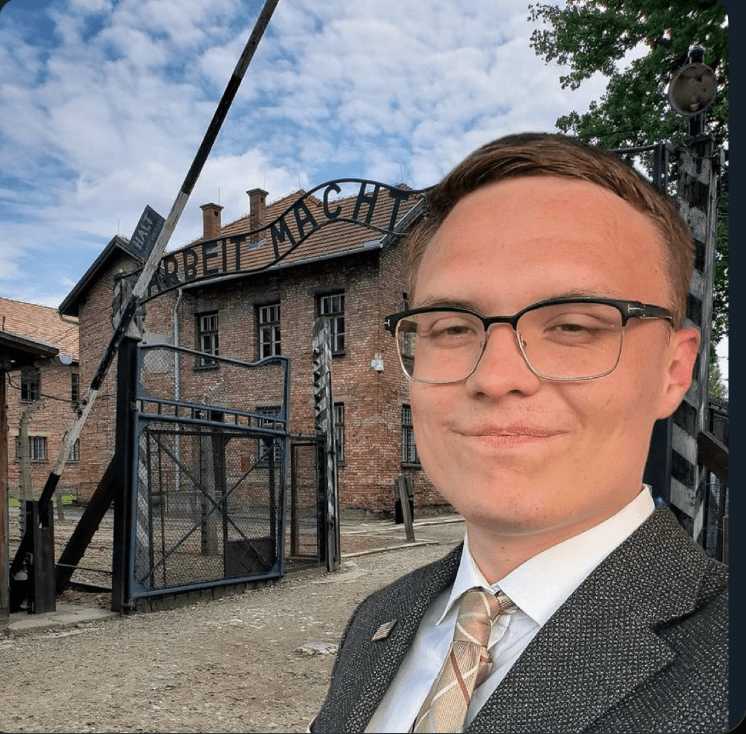
Ted Kempinski Lead Teacher of Holocaust and Genocide Education, Haverhill Public Schools History Faculty, Haverhill High School Honorary Consul of Memory, Auschwitz-Birkenau Memorial Doctoral Candidate, Holocaust and Genocide Studies, Gratz College


Leave a Reply